Willa Black Prints NZ - Māori Legends
Kurangaituku - The Bird Woman
Part woman, part bird, keeper of forests and cloaks. The Māori legend of Kurangaituku - her story, her place in tradition and a contemporary portrait that reimagines her as she deserves to be seen.
In the oral traditions of Te Arawa, there is a figure who has long been cast as villain - wild, fearsome and ultimately destroyed. But read her story more carefully, and something else emerges: a keeper of birds and cloaks, a healer of the injured, a woman betrayed by the person she sheltered. Her name is Kurangaituku.
The LegendWho Is Kurangaituku?
Kurangaituku is a part-woman, part-bird supernatural being from Māori mythology, associated with the iwi of Te Arawa and Raukawa in the Bay of Plenty region of Aotearoa. She is also sometimes known by the name Hine-ingoingo.
She lived in a cave in the mountains near Atiamuri, a forest-covered landscape between Tokoroa and Rotorua. Her dwelling - known as Uruwhenua - was home to many birds, lizards and treasured kākahu (cloaks). In some versions of the legend she is described as an extraordinary weaver, and Te Arawa oral tradition credits her with bringing the art of finger weaving into the culture. Her wingspan could cast shade across the land. Her beak, her claws and her fierce speed made her one of the most powerful beings in the forest.
In most retellings, she is described as an ogress or a witch. But other versions, particularly those informed by Te Arawa knowledge holders, present her differently - as a nurturing caretaker of birds, a skilled artisan and, in some accounts, a woman who genuinely cared for Hatupatu and was devastated by his betrayal.
A warrior in the forest, a wound, a rescue
Hatupatu was a young Te Arawa warrior - the youngest of four sons - out hunting for birds in the forest near Atiamuri when he encountered Kurangaituku. In many versions, both were hunting the same kereru. Hatupatu threw his spear; it missed the bird but struck Kurangaituku's beak. Before he could flee, she caught him and brought him back to her cave.
In some tellings, Hatupatu had been injured and left behind by his brothers before Kurangaituku found him. She cared for him, restored him to health and, in several accounts, came to love him. Her cave was filled with birds, lizards and precious cloaks - a world of natural abundance she had built and tended. Hatupatu lived within it, sheltered and fed.
Different iwi and time periods tell this meeting differently - some as capture, some as rescue, and some as a kind of unlikely companionship that Hatupatu ultimately could not honour.
The birds silenced, the cloaks stolen
When Kurangaituku was away one day, Hatupatu took his chance. He used a taiaha to kill her pet lizards and birds - all except one small riroriro that escaped. He gathered up her precious kākahu - her feathered cloaks - and fled toward home.
The surviving riroriro flew until it found Kurangaituku and sang to her what had happened. She returned to find her home destroyed, her treasures gone and the person she had sheltered gone with them. She ran after Hatupatu at extraordinary speed. He hid inside a rock by chanting the karakia "E te kōwhatu e mātatī, mātatā" - calling the rock to open for him. She waited; he emerged; the chase continued.
Travellers passing the rock near Atiamuri still call it Tē Kōhatu o Hatapatu - the rock of Hatupatu - and it remains a named place in the landscape today.
The boiling springs and her end
The chase led from the Atiamuri forests south toward Rotorua. When Hatupatu reached the geothermal landscape of Whakarewarewa, he leapt over the boiling springs and geysers. Kurangaituku followed - and was burned to death in the hot pools. One pool where she met her end is known as Whanapipiro, and travellers traditionally chanted to placate her spirit there. Hatupatu swam to Mokoia Island in Lake Rotorua, where he returned to his family wearing the stolen cloaks - toroa feathers and a kākā-feather korowai that had once belonged to Kurangaituku.
Best for: understanding how landscape and legend are woven together in Rotorua's cultural geography.
Keeper of birds, master weaver
In some Te Arawa accounts, Kurangaituku is described as a gifted artisan - particularly a weaver. Her cave held many types of cloaks and garments. One version of the legend credits her with bringing the art of finger weaving into Te Arawa culture, and for this extraordinary skill she was named Kurangaituku. She is also sometimes known as Hine-ingoingo.
She is also the subject of whakairo (traditional carving) - the master carver Tene Waitere created a notable carving of Hatupatu fleeing Kurangaituku around 1904-05, now held at Te Papa Tongarewa. And the Kurangaituku Netball Tournament has been held annually in Rotorua since 1933 - her name living on in community sport as much as in legend.
Best for: understanding the fuller, more complex Kurangaituku behind the conventional villain framing.
A story that changes when retold
The legend of Kurangaituku has been passed down across generations and retold by many voices. Each version reflects something about who is doing the telling and what they value. Colonial and early settler retellings typically focused on Hatupatu as hero and Kurangaituku as threat. More recent tellings - particularly those from Te Arawa knowledge holders and contemporary Māori writers - often restore her complexity, her generosity and her grief.
In 2021, novelist Whiti Hereaka (Ngāti Tūwharetoa, Te Arawa) published a landmark retelling that tells the story entirely from Kurangaituku's perspective - from the birds who sang her into being, through her life with Hatupatu, and her death. The novel won the Jann Medlicott Acorn Prize for Fiction at the 2022 Ockham New Zealand Book Awards and was longlisted for the 2023 Dublin Literary Award.
If you want to understand why Māori legend art resonates so strongly in contemporary New Zealand homes, this guide explores exactly that.
One of the most widely read versions of this legend in New Zealand schools, this Stage Seven Supplementary Reader retells the story in simple, accessible language for early readers. Published by Shortland Publications and part of the beloved Story Chest series, it introduced generations of New Zealand children to Hatupatu and Kurangaituku through classroom reading programmes. Joy Cowley remains one of Aotearoa's most celebrated children's authors and the Story Chest series is a touchstone of New Zealand primary school literacy.
Ages 5-8 - School ReaderPart of the Waiatarua Myths series of simply retold stories featuring mythical Māori figures, tangata whenua and creatures like the taniwha. Available in both English and te reo Māori editions, these titles are an ideal reading resource for pre-schoolers, emerging readers and students of te reo Māori. At 16 pages, the books are designed for ages 4-10 and sit easily in classroom collections and home libraries.
Ages 4-10 - Bilingual Edition AvailableAn award-winning novel that retells the legend entirely from Kurangaituku's perspective - one of the most significant retellings of a Māori myth in recent New Zealand literature. Whiti Hereaka (Ngāti Tūwharetoa, Te Arawa) tells Kurangaituku's story from the birds who sang her into being, through her life with Hatupatu and her death. The book is physically structured with two sides - a dark ruru side and a light miromiro side - that can be read from either direction. Winner of the top fiction prize at the 2022 Ockham New Zealand Book Awards. Longlisted for the 2023 Dublin Literary Award.
Adult / Young Adult - Award-Winning FictionOne of the earliest screen adaptations of the legend, produced in 1963 using plasticine puppets for school audiences. The Rotorua Museum also produced an educational resource on the legend used in schools across the Rotorua region, connecting the story to the landscape, the sacred rock Tē Kōhatu o Hatapatu, and the geothermal pools of Whakarewarewa.
Educational Resource - Regional Rotorua
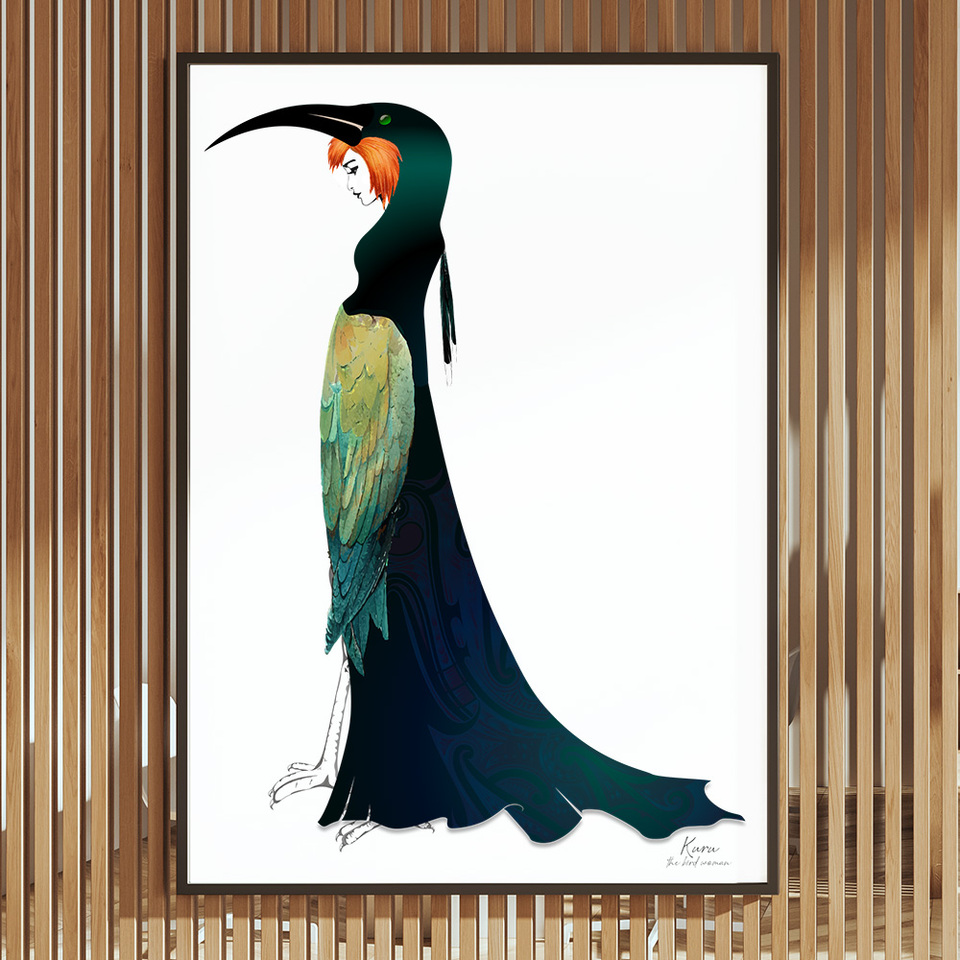
The literature has often cast Kurangaituku as something to fear - a creature, an ogress, a threat to be outwitted and destroyed. The Willa Black Prints Kura takes a different view entirely.
Kura is a striking and thought-provoking contemporary Māori art print that reimagines Kurangaituku as the powerful, beautiful figure she is when seen on her own terms. Part human, part bird - majestic, graceful and fierce. Not a monster to be escaped, but a heroine whose story deserves to be told from her own perspective: keeper of birds, master weaver, woman who sheltered and healed, and who was ultimately betrayed by the person she protected.
This is art that invites a second look at a story most New Zealanders think they already know.
View Kura →"The literature cast her as a monster. The art asks what she might have been if the story had been hers to tell." Willa Black Prints
Her LegacyWhy Kurangaituku Still Matters
Kurangaituku has never disappeared from Aotearoa's cultural life - she simply moved between forms. She lives in place names near Atiamuri and Rotorua. She lives in whakairo, including the masterwork by Tene Waitere now held at Te Papa Tongarewa. She lives in a netball tournament that has carried her name in Rotorua since 1933. She lives in the school readers that introduced generations of New Zealand children to the idea of a powerful, unknowable presence in the forest.
And she lives in the growing body of work that asks what her story looks like when she is allowed to tell it herself. Whiti Hereaka's novel is perhaps the most significant example - but the impulse behind it is older. Versions of the legend sympathetic to Kurangaituku have always existed, told by people who understood that a figure this enduring must carry something more than menace.
She is part woman, part bird. She commands birds and lizards. She holds and protects precious things. She heals the wounded. She is betrayed by the person she loved. She pursues with extraordinary power and speed. She dies not because she was vanquished in battle but because she followed her heart into terrain that destroyed her.
That is not a monster's story. That is a story about love, betrayal, loyalty and loss told from the perspective of someone the original tellers did not expect us to mourn. The more we look at Kurangaituku clearly, the more she refuses to stay small.
Artwork that draws on legends like hers is part of a wider movement - explored in depth in our guide to why Māori legends wall art stands out.
Source: Wikipedia - Kurangaituku
Source: Te Ara - Hatupatu and Kurangaituku
Source: GTAS - Hatupatu and Kurangaituku
Sources and Further Reading
- Wikipedia - Kurangaituku
- Te Ara Encyclopedia of New Zealand - Hatupatu and Kurangaituku
- GTAS - Hatupatu and Kurangaituku
- Cowley, Joy and Melser, June. Hatupatu and the Birdwoman. Shortland Publications / Story Chest, 1982.
- Hereaka, Whiti. Kurangaituku. Huia Publishers, 2021. Winner, Ockham New Zealand Book Awards 2022.
- NZ Herald - Kāhu ki Rotorua: Hatupatu me Kurangaituku (2022)
- Bomford, J. H. (1938). The witch's rock - a Māori legend. The New Zealand Railways Magazine, 13(8).
- Te Ao Hou / The New World, Issue 57 (1966). The legend of Hatupatu and the Bird-woman.
Willa Black Prints NZ
See her as she deserves to be seen.
Explore the Kura art print and the full Willa Black Prints Māori Legends collection - made to order with custom sizing and framing. Ships across NZ and Australia.