Willa Black Prints NZ - Toi Māori
Māori Cloaks - Kākahu
History, meaning and the different types of kākahu - from korowai and kahu huruhuru to kahu kiwi, kahu kākāpō and kahu kurī.
Few taonga carry the same visual presence as a Māori cloak. When a kākahu is placed around someone's shoulders, it can represent warmth, protection, whakapapa, mana and the support of the people standing behind them - honouring achievement, leadership, grief, service or a significant transition in life.
KākahuWhat Does Kākahu Mean?
Kākahu is a broad Māori term for clothing or garments. In discussions about traditional Māori weaving, it is commonly used for cloaks and other woven garments.
Māori settlers brought established Pacific weaving knowledge to Aotearoa, but the cooler climate required new forms of clothing. Weavers adapted the fibres and resources available here, particularly harakeke, and developed garments that could provide warmth, shed rain and display exceptional technical skill.
The basic woven body of a cloak is called the kaupapa. Rather than being made on a loom, traditional kākahu are generally constructed through whatu, a finger-twining technique in which horizontal aho threads are worked across vertical whenu threads.
From that foundation, weavers developed an extraordinary range of garments - from rough working rain capes to prestigious cloaks decorated with tāniko, tassels, dog skin or feathers.
Today, cloaks are often seen at graduations, tangihanga, weddings, investitures, awards, kapa haka events and major public ceremonies. Historically, Māori cloaks also served practical purposes - some protected wearers from rain and cold, while finer garments communicated rank, prestige and identity.
HistoryWhen Were Māori Cloaks Worn Historically?
Historically, Māori wore different garments according to weather, purpose, status and occasion. Rougher capes were practical protection against wind, rain and cold, made using less-processed plant fibres with outer layers designed to direct water away from the body.
More finely worked cloaks required enormous skill and time. These could communicate mana and social standing and were worn by people of rank during important gatherings, ceremonies and public occasions.
Prestige cloaks were associated particularly with rangatira and other high-status people. Historical accounts and artworks show chiefs wearing kahu kiwi, kaitaka and korowai. Some types of feathers - especially those of highly valued birds - strengthened the relationship between the cloak, chiefly status and the spiritual world.
Cloaks were also part of mourning and burial traditions. Te Ara records that tūpāpaku could be wrapped in mats, cloaks and other finery. The term kahu-mōtea refers specifically to a mourning cloak.
Kākahu could also be exchanged as important gifts. A prestigious cloak was not simply apparel - it could carry relationships, memory and inherited responsibility.
The word korowai is now often used as a general term for any Māori cloak in everyday New Zealand English. Traditionally, however, a korowai is identified by its surface decoration - particularly hukahuka, the rolled or twisted tassels attached across the kaupapa. Hukahuka are usually made from muka, the prepared fibre extracted from harakeke, and may be dyed black or twisted into cords. Some related styles use pokinikini, cylindrical strips of dried harakeke with sections of black-dyed fibre.
Korowai appear to have been uncommon at the time of Captain Cook's first visit, but by the first half of the 19th century they had become one of the most popular and recognisable prestige styles. After European materials became available, weavers incorporated coloured wool and new decorative treatments while retaining Māori construction methods. A korowai may include some feathers, but a cloak densely covered in feathers is more accurately described as a kahu huruhuru.
Source: Te Papa - When is a korowai not a korowai? | Te Ara - Korowai and prestige garments
A kahu huruhuru is a cloak decorated with feathers. These cloaks became especially prestigious from around the middle of the 19th century, although feathers had long been valued in Māori adornment and chiefly display. Feathers could be attached in bunches or individually as the cloak was being constructed, arranged according to colour, form and the overall visual plan.
Historically used native feathers included those from kiwi, kākā, kākāpō, kererū, tūī, weka, huia, toroa (albatross) and kākāriki. Birds hold significant places within te ao Māori - some were understood as messengers between the spiritual and physical realms, and the rarity of particular feathers added to a garment's mana. Later cloaks also incorporated introduced bird feathers including peacock, pheasant, rooster and turkey. Contemporary weavers may use legally sourced native feathers where permitted.
Source: Te Papa - Kahu huruhuru style of cloak | Te Papa - Identification of feathers in Te Papa's Māori cloaks
A kahu kiwi is a particular kind of kahu huruhuru decorated predominantly with kiwi feathers. Kiwi feathers create a soft, warm and highly textured surface. Their natural brown, golden, cream and darker tones can be arranged to produce subtle shifts in colour or bold patterning.
Kahu kiwi were highly prestigious. Historical images show chiefly people wearing them, and Te Ara describes a kahu kiwi worn by the Ngāti Toa rangatira Te Rangihaeata as a sign of his high status. Some surviving kahu kiwi contain feathers from more than one kiwi, including variations in tone and rare pale or albino feathers. One Te Papa cloak uses alternating stripes of brown and white kiwi feathers with dyed muka visible inside the kaupapa. Another in Te Papa's collection conceals small groups of huia feathers among the kiwi plumage - demonstrating how significant feathers could be included discreetly within a larger design.
Source: Te Papa - Māori feather cloak with kiwi and huia feathers | Te Ara - Te Rangihaeata wearing a kahu kiwi
The term kākahu kura or kahu kura may refer to a cloak decorated with prized red feathers, particularly those of the kākā. Red feathers were associated with chiefly prestige throughout Polynesia. Within Aotearoa, red kākā feathers were highly valued and could create striking garments.
The availability of the required birds meant these cloaks demanded considerable resources, relationships and labour. Their colour and rarity gave them immense visual and social impact.
Kākāpō feathers were also used in highly prestigious cloaks. The bird's yellow-green, brown and softly patterned feathers created a distinctive surface. Te Ara records that kākāpō were used as food and that their beautiful feathers were made into cloaks for high-born people.
Surviving examples are rare and culturally significant, particularly because kākāpō are now a critically endangered protected species. These cloaks serve as a reminder of the ecological richness of pre-European Aotearoa and the depth of relationship between Māori and the natural world.
Before the extinction of the Polynesian dog or kurī, dog skin was used to make some of the most prestigious Māori garments. A kahu kurī could be made from carefully cut strips of dog skin attached over a woven foundation. Some versions used the tails or other selected parts of the animal.
These garments were strongly associated with rangatira and mana. They were durable, visually distinctive and exceptionally valuable. Because kurī became extinct following European settlement, kahu kurī belong to an earlier historical period and surviving examples are now rare museum and whānau taonga.
Source: Te Papa - Kahu kurī
A kaitaka is a finely woven muka cloak admired for its smooth, almost silk-like body. Unlike a feather cloak, much of the visual beauty of a kaitaka comes from the quality and regularity of its muka foundation. The lower borders may be decorated with elaborate tāniko.
A kaitaka huaki has tāniko borders arranged so the decoration remains visible when the cloak is worn open. A kaitaka ngore-ngore may carry additional fringes or decorative elements. These were garments of great prestige, displaying the technical excellence of the weaver through the fineness of the muka and precision of construction.
Not every Māori cloak was a ceremonial object. Garments such as the pake, hieke and pūreke were made for protection from wet weather. They often used unprocessed or partially processed harakeke, kiekie or other plant materials. The outer fibres helped water run away from the wearer, functioning much like thatching.
These practical cloaks remind us that Māori weaving was not divided neatly into art and utility. Even garments made for hard weather involved detailed environmental knowledge, material selection and sophisticated construction.
Source: Te Papa - Styles of Māori cloak
ConstructionWhat Is Underneath the Feathers?
The feathers are not the structural base of a traditional feather cloak. Underneath them is the kaupapa - the woven or twined body of the kākahu.
This foundation was traditionally made from muka. Harakeke leaves were harvested and carefully prepared to extract their strong inner fibre. The muka could be washed, softened, rolled and sometimes dyed before weaving began. The vertical foundation threads are called whenu, while the horizontal twining threads are called aho.
During construction, feathers or decorative elements are incorporated into selected rows. The placement must often be planned before and during weaving, particularly where colours form deliberate patterns. The inside of a feather cloak can reveal the extraordinary precision of the weaver - even when the outer surface is almost completely concealed by feathers, the kaupapa beneath may contain carefully spaced rows, shaping and dyed fibre details.
TānikoWhat Is Tāniko?
Tāniko is a specialised form of finger weaving used to create dense geometric patterns. It is often seen along the borders of kaitaka and other fine garments, as well as on belts, bodices, headbands and decorative bands.
Traditional tāniko used muka in natural, black, yellowish and reddish tones. Black muka was commonly produced using iron-rich paru or mud in a process requiring careful knowledge and preparation. Following European contact, brightly coloured wool and commercial fibres were sometimes incorporated into tāniko and cloak decoration.
Tāniko is not simply printed patterning placed on top of a cloak. It is built structurally through the manipulation of threads. Its geometric precision is evidence of advanced planning, counting, tension control and inherited knowledge. Individual designs may have iwi, hapū, whānau or weaver-specific associations - it is therefore safer not to assign one universal meaning to every triangle, diamond or stepped pattern without knowing the context of the piece.
Source: Te Papa - Tāniko definition
Gender and RankDid Men and Women Wear Different Cloaks?
There was not a simple rule that one cloak type belonged only to men and another only to women. Men and women both wore kākahu. The appropriate garment was shaped more by rank, whakapapa, purpose, resources, region and occasion than by a universal gender division.
Historical records frequently show male rangatira wearing prestige cloaks because colonial artists and writers often focused on chiefs and political leaders. That does not mean prestigious kākahu were exclusively male garments. Women of rank also wore and inherited significant cloaks. In contemporary practice, women and men may both be cloaked during graduations, weddings, tangihanga, awards, pōwhiri and leadership ceremonies.
Some garments or styles may have been designed with a particular wearer in mind, and iwi traditions can differ. But it would be misleading to describe korowai as women's cloaks or kahu kiwi as men's cloaks. The deeper distinction is usually one of mana, occasion and whakapapa rather than gender alone.
Contemporary UseHow Are Māori Cloaks Used Today?
Kākahu remain living taonga. They are still made by highly skilled kairaranga and worn or presented at important events including:
- University and tertiary graduations
- Tangihanga
- Weddings
- Pōwhiri and marae occasions
- Investitures and civic honours
- Cultural and community leadership events
- Kapa haka
- School and university ceremonies
- Significant birthdays and whānau milestones
- Sporting and national representation
Since 2004, New Zealand's Olympic flag bearer has worn Te Mahutonga, a cloak made by renowned weavers Te Aue Davis and Ranui Ngarimu and named by Te Arikinui Dame Te Atairangikaahu.
Cloaks may also be created for organisations and offices of responsibility. They can be worn by successive holders of a role rather than belonging permanently to one individual. Some whānau cloaks are held collectively - a kaitiaki may care for the taonga and bring it out for significant events such as tangihanga or graduations. The cloak therefore carries not only its physical materials but also the memory of those who have worn it.
TikangaCan Non-Māori Wear a Māori Cloak?
There is no single answer that applies to every cloak or situation. Some kākahu are personal or whānau taonga connected to specific whakapapa. Others are created for organisations, public roles or as gifts to distinguished people, including non-Māori. What matters is the authority, intention and tikanga surrounding the particular cloak.
Wearing a kākahu should not be treated as costume styling. It is appropriate to understand:
- Who made the cloak
- Who owns or cares for it
- Why it is being placed on the wearer
- What occasion it is intended for
- Whether permission has been given
- What tikanga accompanies its use
When a person is formally cloaked by the whānau, weaver, organisation or kaitiaki responsible for it, the act can represent honour, support and collective recognition.
TaongaMore Than a Garment
A Māori cloak is never defined only by its feathers, tassels or pattern. Its significance can also come from:
- The hands and knowledge of the weaver
- The whakapapa of its materials
- The people for whom it was made
- The occasions on which it has been worn
- The whānau or community that protects it
- The memory of earlier wearers
- The kaupapa it continues to represent
This is why kākahu can become taonga tuku iho - treasures handed down through generations. The cloak gathers story as it moves through time.

Awhi Mai wears a cloak directly inspired by the korowai tradition. Her collar is lined in toetoe grasses and her garment references the layered protection, mana and whakapapa that a korowai carries when placed around someone's shoulders. Her hair is adorned with ponga, koru, harakeke and mānuka - speaking to new life, growth and healing - and a pounamu manaia pendant rests near her heart as a symbol of protection and guidance.
This is the korowai not as a museum object but as a living visual language - worn by a contemporary wāhine Māori and carrying all the warmth, strength and cultural weight the garment has always held.
View Awhi Mai →
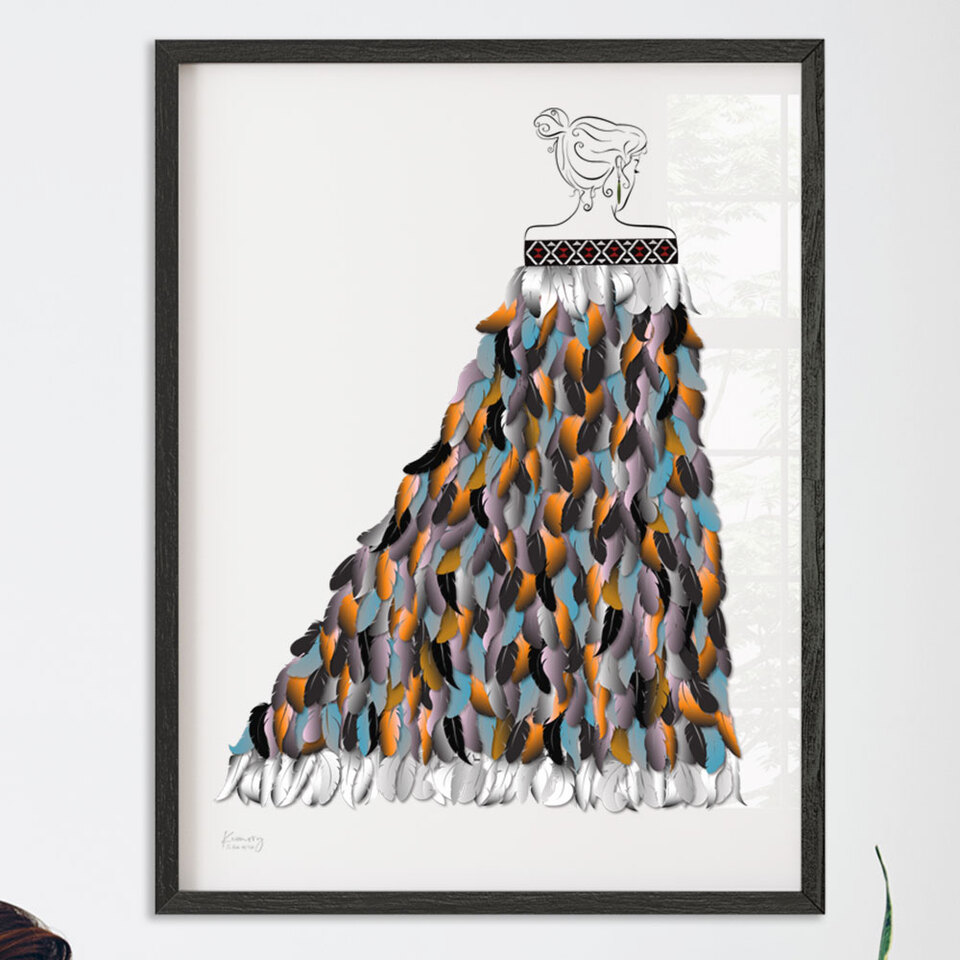
The form of a cloak continues to inspire contemporary Māori artwork because it communicates protection, identity, mana and connection so immediately. In visual art, a cloak may represent more than clothing - it can suggest the presence of tūpuna, the strength of whakapapa or the feeling of being held by whānau and culture.
The Willa Black Prints Te Kahu Limited Edition draws on this emotional language of the cloak. The artwork does not attempt to reproduce a museum kākahu as a technical weaving study. Instead, it interprets the cloak as a contemporary symbol of protection, dignity, identity and presence. That distinction matters - traditional kākahu are living taonga made through specialised knowledge and tikanga. Contemporary artwork can respectfully respond to their meaning without claiming to replace the work of kairaranga.
View Te Kahu Limited Edition →"A korowai carries hukahuka. A kahu huruhuru carries feathers. A kahu kiwi carries the soft plumage of kiwi. A kaitaka displays the beauty of finely prepared muka and tāniko. A rain cape carries generations of practical environmental knowledge. They are worn, gifted, guarded and handed forward." Willa Black Prints
Key Research Sources
- Te Papa - History of Māori cloak-making
- Te Papa - Styles of Māori cloak
- Te Papa - When is a korowai not a korowai?
- Te Papa - Kahu huruhuru style of cloak
- Te Papa scholarly research - Identification and description of feathers in Te Papa's Māori cloaks
- Te Ara - Māori clothing and adornment - kākahu Māori
- Te Ara - Māori weaving and tukutuku - te raranga me te whatu
- Te Ara - Ngā manu - birds as symbols of status
- Te Ara - Kaitiakitanga of inherited taonga
- NZ History - Contemporary ceremonial use of a korowai
Willa Black Prints NZ
Bring cloak symbolism into your home.
Explore Awhi Mai, Te Kahu and the full Willa Black Prints Māori art collection - made to order with custom sizing and framing. Ships across NZ and Australia.